The bullet holes in the building next door

As I sit here in this third floor apartment alone thinking and devoting, I just looked out the window as I heard some birds singing and I noticed the bullet holes in the building next door. I was wondering what this place must have been like 10 years ago when the fighting was most intense? I wonder who was in that apartment when someone took an automatic weapon and fired it at their window with the hope of killing someone inside?

I have noticed that many of the buildings here still bear evidence of gunfire and a few of them even bear evidence of mortar fire. Here is a photo I took last week in Bosnia which shows the kind of destruction I am talking about.


Of course we Westerners ooh and aah in amazement when we see things like this but there were people dying in these buildings during the war. This was not a movie.

Nor or things miraculously healed when a political agreement brings an end to the fighting and dying. A couple of weeks ago I got horrendously lost here in Croatia and there are almost NO road signs, and I stopped the car several times and asked people (yes real men ask for directions) if the road I was on was the road to Belgrade? Most just turned around and walked the other direction when I mentioned Belgrade. One man yelled at me incredulously, "Belgrade!???" and then stomped off. Not a single person was willing to tell me if I was headed in the right direction or not. And I instantly became the enemy when I said the word Belgrade and it became known that I was headed that way.

What does the Gospel offer these folks and who will give it to them? How will they hear without a preach, and how shall they preach unless they be sent? Will the preacher be able to live in a place that neither appreciates him nor wants him?

What is good about Good News to the poor?

As you can see from this photo I took this week, Macedonia is home to Muslims. It is also home to the largest concentration of Roma (often called Gypsys) people anywhere in the world. Now we had gypsys in Russia when we lived there, but those gypsys were very different than the gypsys that live here in Macedonia. These people are the poorest of the poor. As I was working out along the river this morning, I saw once again that a small clan of gypsys had set up a rambling shamble of card-board buildings that they are living in. Come met a few of their children . . . it will break your heart and tear a hole in it.


Jesus defined His arrival as the Messiah by stating that Good News has come to the poor (see the last post "the ghost of pan-missionism"). But what is good about good news to the poor? If we could only define this, if we could only answer this question, then we may understand what is good about the Good News for all of us.

The Lausanne II conference in Manila stated "The good news is that God established his Kingdom of righteousness and peace through the incarnation, ministry, atoning death and resurrection of his Son Jesus Christ. The Kingdom fulfills God's purpose in creation by bring wholeness to humanity and the whole creation . . . Those who respond to this good news who are poor in the material sense or powerless are empowered by the Spirit and served by other members of the Kingdom community to experience full humanity . . . the non-poor who become poor-in-spirit receive true dignity replacing false pride in riches and are liberated to be truly human with a passion for justice for the poor."

This amazing statement ends with this kicker . . . "The task of evangelisation among the majority of the unreached who are poor will be carried out primarily by those who are poor, with appropriate support from those economically advantaged who are poor in spirit."

So unlike some North American preaching I have heard in my many years, that the good news means all things become new, e.g. no more mortgage, no more credit card debt, jobs with tenure, and never a financial worry ever again in life . . . that message just doesn't preach in Shutka, the Roma neighborhood. They are poor . . . poor in a such a manner that few can imagine in the West. Don't confuse poor with "a difficult time." The poor have no hope that it will ever get better or easier . . . ever.

So what is good about the Good News to the poor? Three things: dignity (identity), status and worth. Dignity literally means a sense of self-worth. This gives one identity, which answers the question "Who am I?" while dignity more answers the question "What am I worth?" (this is an argument that Christopher Sugden lays out). Look at those two questions! The Scriptures and a relationship with the living God, yells out the answers to those two questions. Look at Luke 15 and see Jesus being marginalized by the religious people because he was hanging with sinners. Then read the rest of the chapter and see WHO the lost are and WHAT VALUE the lost have . . . I am a son of the living God, that's who I am! And what am I worth? Well, everything.

Next time I will have to write about the second part of the kicker . . . about us economically advantaged folks.

The Ghost of pan-missionism

Walter Freytag used the phrase "ghost of pan-missionism" to describe the phenomena of calling all ministry missions. In fact, what is usually meant is evangelism, not missions. Earlier in our history we defined missions geographically or theologically. Theologically defined along the lines of van Ruler's argument that one must distinguish between a Westerner and a non-Westerner. van Ruler insisted that the Westerner has brushed against the idea of "God-in-Christ" for much of our history and this cannot be undone. Even a de-christianized European is not a pagan. Bosch says that he can never become pre-christian again, only post-Christian. But I am getting side-tracked . . .

If evangelism and mission are primarily understood as verbal proclaimation, then geographically and theologically they are indistinguishable. But if we look at the nature of the two, then perhaps we might/could agree with John Stott's ascertion that mission is a comprehensive concept, "embracing everything which God sends His people into the world to do". Evangelism on the other hand is less comprehensive and is actually a component of mission. Mission is then defined by Stott as "evangelism plus social action." I actually don't like Stott's phrase here, but missions is about crossing frontiers of geography, language, cultures and world views. In fact I agree with Bosch that evangelism is something more than merely a component of mission and mission is more than evangelism plus social action. Evangelism is an invitation to leave one life and embrace another, it is not merely the verbal proclaimation of objective truth (which in our modern world, does not exist anyway according to the masses).

BUT it involves more than verbal proclaimation of the Gospel. Remember when Jesus began His ministry in Nazareth he quoted Isaiah and outlined what He came to do: "The Spirit of the Lord is upon me because he has annointed me, he has sent me to announce good news to the poor, to proclaim release for the prisoners and recovery of sight for the blind; to let the broken victims go free, to proclaim the year of the Lord's favor." Now you gotta admit, there is a bit more there than verbal proclaimation! Evangelism is a dynamic expereince where the person receiving the gospel and the person who is sharing the gospel create a dynamic synergy that is evangelism. Of course the contents of evangelism will be different for one location over another, with one social situation versus another.

The Evangelical view of missions generally can be summed up in the GC in Matt. 28:19-20. It is given urgency by a conviction (in Evangelical circles) that people who have not heard the gospel will perish eternally. The problem here (and this is another subject all by itself!) is that, as Bosch correctly states, the gospel becomes primarily "a subject for belief" rather than "a way of life." It becomes a message which if accepted gives the person entrance into the Kingdom. I think we evangelicals have ventured out onto thin ice here. This view of missions/evangelism turns people into projects, and makes evangelism a magic wand religion where one can say the magic words and the door opens (wasn't that alli-baba?), and lets face it everyone wants to be saved from hell but few want to be saved from sin.

As I look at us evangelicals, it seems that we believe that we have been saved from hell, but weren't we also saved from materialism, me-ism, nationalism, selfishness, gluttony, lying, gossiping, hatred, and retirement planning? It seems that I want fire insurance far more than I want the rest of the package. What ever happened to the idea that salvation was a life?

don't watch the wrecks!

OK, I admit it, I was rubber-necking. Doesn't everyone? As you can see from the photo, it wasn't much of a wreck anyhoo . . . BTW that little car is known as a Ficho, which is the Yugo version of a VW bug, except it looks like a pregnant cockroach. And I was making my twice weekly ride up the mountain on my bike and I came up on this just-happened accident and I was trying to figure out who got hurt and how the accident happened and if perhaps they had run over a cyclist such as myself with this particular damage to the car.

Now when you are rubber-necking, you generally are not paying attention to other things, and of course this can have significant consequences for the driver of a car, but even more so for a cyclist . . . because what is at every accident? Of course, broken glass! So while I was slowly huff and puffing past this tiny accident and not watching the road, I was driving through loads of broken glass!

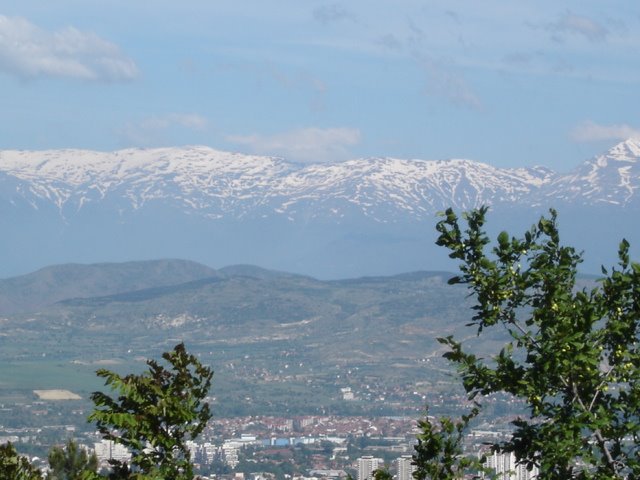
Not only was the accident distracting me from the negatives, but it was also distracting me from some powerful positives! It was literally keeping me from seeing the glory of God! This morning was an unusually beautiful morning . . . the rain from around midnight having cleaned our polluted air to the point that you could see the entire northern mountain range which are still snow covered even if it is the 18th of May! Here is the view that I was missing!!


Of course this little photo cannot convey the distances and majesty and scope of the scenery, but at the risk of sounding redundant, it was magnificient -- the splendor of God on display!

As I continued on my ride fully expecting my tires to go flat at any moment because of my idiotic distraction with the little accident, it occurred to me that I often, most days in fact, live my life just like that. Perhaps I don't see a car accident everyday, but the urgency of the immediate, the constant noise of the modern world in music and video/tv, the mundane trivia of everyday work, the pressure of deadlines, the insane schedules of the modern world, the overwhelming input of information, the everyday scream of constant distractions, or as Lynn Joesting Day describes this phenomena as "human enthusiasm for unexamined change" constantly grabs and unfortunately holds my ever-shortening attention span, I often miss the dangers in my life and the glory around me as well.

I think I need more immunity to the attraction of the loud and obvious, and more awareness of the dangers and glory in life. Help me Lord.

an atheist by the grace of God

An oxymoron you say? I am not so sure. I recently heard someone use Paul's contextualization on steriods (be all things to all people in order to win some) to become a nihilist for the nihilists and godless for the godless. One person suggested that the entire language of the Church has become meaningless and so he said that he had become "an atheist by the grace of God."

Now as a person who has always need much grace in my life, I can sympathize with anyone needing grace. But God giving grace to a person in order that they can believe that no god exists? Some would argue that if the world is the area of God's activity, that would certainly include religious viewpoints other than Christianity. In the end it seems that one would just end up arguing for the Buddhist to be a better buddhist and the Mormon a better mormon if this position goes to its logical end.

Is this what Paul meant? I think the view above is too extreme a reaction away from the clear meaning of the passage. On the other hand, the radical effects of the conservative evangelical perspective that the world is evil, contact should be avoided with the world entirely when possible, I mean our citizenship is in heaven not here on earth -- creates a huge disconnect with life. Isolationism and insulated lives result. There seems to be no balance on either side . . ..

Generally I like extremes . . . some would even argue that I personally am really extreme! On the other hand it seems imperative to understand/admit that God has left us in this world. We evangelicals seem to be focused a great deal on the glorious future when the saved individuals are with God in heaven. But what about today? Really? If the world is essentially evil, which means our environment is essentially evil, how does one remain unstained by the world, much less become all things to all people so that some might be saved? And isn't salvation more than just getting more souls into the Kingdom in the future? What about today? Would not the redeemed directly address the injustices of this world? So what should I do about the lady picking food out of the garbage dumpster on my street? The beggar who grabbed my leg this morning and wanted money for food? The lady in our church who lives in one room, with no water or toilet? The girl begging at the street corner who can't read or write and doesn't want to . . . she only wants to get married (she is 13)? What about homosexuals, pollution, war, refugees, hunger, human trafficking, and ethnic hatred? And these are the problems just in my neighborhood!

I guess being an atheist by the grace of God is no stranger than a salvation that doesn't change the world, only the final destiny of an individual.

AK-47

It's been a while since I have been this close to a Kalashnikov. Yesterday while crossing into SCG (Serbian/Crna Gora) from Croatia I needed to exchange some US currency (which is falling in value faster than the hailstones I got nailed with yesterday in Belgrade) into Serbian Dinar. The Serbian border has always had a Wild West feel to it and even more so now, when they are in the middle of construction and you have no earthly idea which way you are supposed to go.

They have moved the insurance-exchange-banking-customs offices to one side in these little modular buildings. The first three exchanges/banks I stopped in told me to go to the next one (well, as far as I could understand since I don't actually speak Serbo-Croatian . . . but I can usually understand about 65% since it is halfway between Russian and Macedonian). Sooooo when I arrive at the door of the fourth exchange/bank, I started to enter, but there was a man there holding an AK-47 (it wasn't one of the new AK-74's) sorta half blocking the door. As I was out in the sun and he was inside, I did not realized that he was an officer of some type. It is very unusual for anyone other than a military officer to carry a submachine gun in public. Most police officers have pistols. And I asked, "may I exchange money?" and received no answer. My internal SYRE (save your rear end) radar was not flashing warning signals loud enough to slow me down . . . so I came inside and found the atmosphere rather tense.

When I spoke I gave myself away as a foreigner, and while my spoken words may have implied I was a Macedonian, my dress clearly identified me as a foreigner foreigner! That is a non-former-yugoslav. So the young man with the Kalashnikov was tense and worried. When the man holding the gun is worried, then generally I worry too. Once I was inside and at the window, everything suddenly made sense. There was a cash delivery being made and I essentially had crashed a private party. Until the man carrying the huge bag of money and the man with the AK-47 left the little room, I neither moved nor spoke. While I generally have all of the emotional sensitivity of a crocodile, my self-preservation instincts are top notch.

It was the weapon itself that I kept looking at though, and that made the young fellow holding it even more tense. What I decided that I would not tell him, was that while in Russia, I had heard many stories about Mikhail Timofeevich Kalashnikov, the designer of the very submachine gun this young man was nervously caressing. My foreignness and abrupt entry, combined with interest in his weapon, not to mention who knows how much money being passed from the safe into a large leather bag handcuffed to his friend created an atmosphere that was edgy.

All I had really wanted to do initially was talk about the AK-47 (OK OK I wanted to hold it too) and exchange my meager $200. Now I would have been content to leave and go outside, but I was essentially afraid that the young fellow would perceive movement to be threatening. So I held still in body and I held my peace too. The feeling in that little office lightened considerably when these two characters left.

As I got back in my Peugeot and headed down the Serbian highway, it occurred to me that it would not have taken too much to have made that little encounter have a very different ending. Such little episodes in my day remind me of how precious life is . . . so I called one of my daughters when I got home and gave my wife a big hug. Yeah, life is precious, and God protects the simple.

the stench of a rotting corpse

Smells are amazing . . . they can bring back memories from many years in the past. Or they can make a moment most pleasant (see previous blog about the smell of heaven). Or if you have ever lived in some hairy arm-pit sort of place around the world, you certainly know that smells can be utterly awful.

So I found it facinating this morning to read that apparently to non-praying folks -- those headed toward destruction, find our "smell" to be like that of a rotting corpse! Now that is some serious bad smelling. Before I got married some 20 years ago, I drove an ambulance and in the course of that difficult job, received the opportunity to smell a rotting corpse. There is nothing, and I repeat nothing, that is quite as bad a smell as a decomposing human body.

In the same text, it is written that to those who are on the path of salvation in some fashion, we are an "exquisite fragrance" and it occured to me that the same thing is the stench of a rotting corpse and an exquisite frangrance all at the same time! This is a bit confusing, but the most facinating thing is that this entire discussion about smells is written in the context of hearing from God and communicating what we are told. It says, "This is a terrific responsibility. Is anyone competent to take it on? No--but at least we don't take God's Word, water it down, and then take it to the streets to sell it cheap. We stand in Christ's presence when we speak; God looks us in the face. We get what we say straight from God and say it as honestly as we can." (2. Cor. 2:16-17 The Message)

It seems that when I communicate the words of God, that these fragrances are released! I wonder what smell I am? At first glance I thought the receptivity of the message by the receiver (hearer) determined the odor, and there is an element of that here . . . but in the end, it seems much more that when I clearly really hear from God and communicate that well, or not (the hearing or the communicating), that the resulting praxis determines the odor. I wonder what smell I am?

The Atomic clock?

The atomic clock what a good idea . . . a clock that receives a signal each day that resets the time correctly so that you never have to think about if your clock is fast or slow . . . no, it's just right. According the folks I am staying with in Mostar right now that is a fine threory, but their atomic clock can be a half hour off, or 10 minutes off, or 10 hours off occasinally.

In fact Mark got up several hours earlier than necessary yesterday because the atomic clock that they have (which beams the time up on the ceiling) was couple of hours off. Clearly this clock is having a difficult time receiving the signal correctly. Or perhaps it is the high mountains surrounding Mostar. Perhaps it is the clock itself! But something certainly is not working right and the results are missed sleep, confused sleepers, and general chaos.

Boy what a picture of my communication with Christ! My signal cetainly get's crossed sometimes, or I am not picking up the signal at all. Maybe it's the mountains surrounding me in life, or perhaps it's just me. But one thing is for sure, just as an atomic clock that can't get the signal right is fairly useless as a clock, a Christain who can't receive, hear or understand the signals of his Savior correctly is pretty useless as a servant.

I think I will go signal-getting again, with my antenna all the way focused.

Where will I be buried?

The question of salvation is not only a event versus process question, but there are other significant issues that come into play from the perspective of those who live in Eastern Europe. As Mark and Kathy Eikost were pointing out to me earlier this week, for Romy people living in Bosnia the first question related to salvation is, “where will I be buried?” The Romy have their own cemetery, but it is considered a muslim graveyard and the Hoja (muslim cleric) will not allow the potential convert to buried in their traditional cemetery. Nor will the Catholics allow the potential convert to be buried in their graveyard. So the potential convert has no place to leave his or her mortal remains. What is a person to do? What should we perhaps try to accomplish in this situation? Are there steps that we can take as missionaries to resolve this dilemma for these potential converts?

The question of where I will be buried has larger implications than only for Romy converts. It’s a question I need to ask myself. Where will I be buried? Where will my final resting place be? Will it be here in Macedonia? Will it be somewhere else in the world where I might travel and work? Or will I return to my childhood hometown and find my final resting place there? These questions are important for more than a final resting place answer, because the answer to the question also frames what I am doing with my life. This then raises the question for me, is what I am doing worth dying for? Ok, of course all of you really spiritual people out there will immediately answer yes, but I am not sure some days. The price of what I am doing grows higher each year, and the costs to me personally in this life seem to have an inflationary tendency -- to always costs more. So I do not want to give a flippant answer. I need to think more about whether salvation is an event or a process (or both as most suggested in their comments), and I certainly need to think about where I am going to be buried.

I think I will go and . . . think.

Event salvation, e.g. magic word theology

North Americans think of salvation as an event, as a point in time where I can point to this day and say "I was not a Christian" and point to the next day and say "I am a Christian." Interestingly enough, the students in my Biblical Theology of Missions class believe that people come into the Kingdom in a process. There is no saying some magic words (repeat this prayer after me) and the immediate result being entrance into the Kingdom of God. My students admitted that perhaps that intense moment in time, that peak occurs sometimes, but the common experience of people in the former Yugoslavia is not like that. They come to Christ is tiny little steps and only Christ Himself could possibly discern when a person crosses into the Kingdom. Here it seems that an individual eventually comes to the realization that he or she is depending upon the justification and righteousness of Christ in faith (Rom 5:1), rather than trying to be good.

This really came to a head last year as we had a country-wide evangelization with a group of folks from California. They brought in some regular folks from their church, who had powerful testimonies. These men and women had honestly great testimonies and communicated them well. We took these communicators from the states around to our friends and acquaintances here and sat and drank coffee, and the locals heard these stories and at the end were asked if they would like to receive Christ as their personal Savior. About 80 percent of them said yes. All of those 80% were then lead in a repeat after me prayer . . . and some wanted to pray themselves. We were all thrilled and were rejoicing from our hearts. A year later?? Where are they?

In reality they are not in our churches. Our follow up with them was good, your connections with these individuals remains strong. I think that the real issue here is the magic word theology, the event salvation perspective. Maybe this works and really happens in America . . . but our folks seem fairly immune to coming into the Kingdom of God with a few magic words.

The dead on the mountain

Today I discovered that Bosnians like their dead on the mountain.  My co-worker Mark sent me on a bike ride up the mountain above Tuzla Bosnia.  And he implied that I could not possibly pedal my bike up that hill.  And of course that makes me want to say "of course I can" or "I can do it!"  According to Mark it's a 32.8% incline.  Who knows if that is true or not, but I will tell you that it was so steep, that when I was sitting and pedaling the front wheel was coming off the ground . . . and when I standing up and pedaling, the rear wheel would spin and lose traction . . . and of course Mark did not tell me that the asphalt was going to become cobblestones which are totally useless for traction because they are granite . . . the bottom line is that I couldn't.  I said that I could.  I thought that I could.  I wished that I could.  But I couldn't.

As I was passing the third graveyard on the mountain, two thoughts occurred to me.  One was that all of these people in the graves may have gotten there by trying to bike up this mountain!  Two was that the main point from the very sermon that I preached this morning applied, I can't do it on my own.  That is why Jesus declares me justified by faith (Romans 5:1), cause I can't be justifed through my own effort.  So I finally gave in to gravity and got off the bike and walked in the steepest points.  I guess I will apply my own message and be thankful for the justification and righteousness of Christ.  He sees me clean and just.  I feel better already.

The ethnic-social challenge

While teaching a seminar on leadership today in Tuzla, a huge discussion erupted over the issue of the challenge of planting homogeneous churches versus heterogeneous churches. Most current missiological thinking and church-planting models have given in, to fallen humanity and conceded that homogeneous church planting is just about the only way to reach niche segments of the population of whatever target group you are reaching for.

The object of today's loud argument was my efforts to get the local church leadership to consider planting a new church that targets the large number of adult students that come to their excellent English school. The pastor was having none of it! He has stuck adamantly with this position for the last two years that we have been discussing this. His rationale is that the church must be different than society! And in the former Yugoslavia, ethnic tensions are our theme. The Serbs live in their neighborhoods and the marry their own. The Croats do the same, and the Bosniaks do the same. The church must not have these divisions. I think his point has some serious validity . . . and some serious consequences.

I was suggesting that targeting the middle class group needs to happen, and the pastor was arguing more for an ethnically unified church, . . . the central question still may be, must the church take a different stand than society? One side of me thinks so, but another side of me thinks that the only human result from that spiritual desire is that no middle-class Tuzlans will come to Christ.

Does this mean that I have no faith? Does this mean that my missiological perspective is informing my theology, rather than my theology framing my missiological perspective? In the end I conceded to the pastor that I am not God (thankfully!) and that my words are neither prophetic nor infallible. I was only reporting the results and trends in modern church starts around the world. My heart hopes that in the end he is right and it comes about that I just lack significant faith. But my fear is that the middle-class of Bosnia may not be well represented around the throne.

Return address?

"What do you mean I can't send the letters?" I asked the postal worker in Croatia for the third time! Obviously he was not understanding me, that I do not have a local address and if the letters are returned for some reason, I want them to come to my house in Macedonia, not some address in Croatia. "Oh you are just trying to force us to mail these letters to Macedonia!" the old fellow replied.

I thought to myself, he is not getting how ludicrous this whole scenario has become. He is suggesting that I am paying a premium airmail price to send these 14 letters to America, just so that I can get them into Macedonia?? It would clearly be much much cheaper to send the letters directly to Macedonia!

I have lived in four different countries, and have visited 30 plus, and have mailed letters from at least 15 different countries . . . and I have never ever in my whole experience had a post office refuse to mail a letter for me, because the return address was in some other country than the post office itself! And just when I thought that I had had every possible experience that a person could have in a post office.

It was a good lesson for me . . . one, that I have not yet experienced all that can be experienced in a post office, and two that there are different perspectives on the nature and work of post offices around the world. Spiritually I also have not experienced all of the Kingdom of God has to offer or that God even has for me personally, and two, there are different perspectives on the nature and work of the Kingdom of God within the Kingdom of God.

As I have been teaching Biblical Theology of Missions this week at the Evangelical Theological seminary in Croatia, I have been appalled at how small a percentage of the students feel the slightest urgency to evangelize a lost world. Even when I confront them with the overwhelming numbers of lost people in the world and how difficult it is to reach them . . . they seem to be utterly content in their salvation without the smallest concern about someone else's salvation. Today in the class discussion I realized that this phenomena is most likely connected to the fact that these churches in the Balkan Peninsula were planted with a local vision only, never a global vision. Now the question for me as their teacher-mentor is . . . how to interject into their personal lives and the life of their churches, a global vision? Can that even be done? I certainly seem to be using the wrong return address.

I wonder if the Bosnians will send my letters for me later this afternoon?

Dear Sin!

This was the salutation that greeted me this morning as I opened an email from one of my Romanian students. It certainly caught my attention. One can only hope that it was a mistake and the intended salutation was Dear Sir. It is attention-getting for other reasons though.

It could be that we all need to write a letter of goodbye to the sin in our lives. IT was interesting in class today as we debated if the lost are really lost or not, how many of the objections to evangelism and missions were personal issues and person distractions.


For soldiers, aren't those distractions considered the highest form of treason? Would not all or anything that robs our attention of His tasks, goals and mission be considered horribly wrong? Perhaps we all should write some Dear Sin letters and tell them goodbye!

Land Mines?!

I was talking with Greg right before my Biblical Theology of Missions class was to begin . . . after teaching the class I wanted to ride the good ole' Carrera on some of the Croatian roads and trails. As he was telling me where to go, I noticed that he said "stay on the road/sidewalk about three times, I held up my hand for a time-out sign! "Why do you keep telling me to stay on the road and sidewalk? I asked. "Because there are still lots of land mines out there and the only way to avoid them of course is stay on the road and sidewalk" was his answer!

Well needless to say, I can think of a few hundred other ways to avoid land mines, like a vacation in the Bahamas, teaching at a seminary in Tahiti instead of the former Yugoslavia, but I said nothing and shook my head yes. And I did stay on the road/sidewalks and I yet live to write this blog. But Greg was not joking . . . there are signs everywhere along the direction that I was riding today, warning the person who values all their limbs and very life to stay on the road! There were even mines underwater in one place! And when I got to the turn-around point in my trip, there was a group of people de-mining right beside the path I was riding on!! Yikes.

Interestingly enough we talked about some serious spiritual land mines in class today . . . the exclusivity of Christ, the lostness of man and hell. The dialogue was great in class, although we kept flipping between a number of different languages . . . we communicated that these are both the reasons and often the stumbling blocks of missions. Most of all today I just wanted them to start forming their own biblical theology of missions. Me giving them one is rather pointless in my opinion . . . they will forget it within an hour of the final exam. But if they get God's point of view for themselves, then it might change their lives. I can only hope.

What does Heaven smell like?

This afternoon I was mudding along on my Carrera up the mountain in the spring rain (after church and a great lunch with the AoG missionaries here in Skopje at a local dive known as Lutsz), and the SMELL was heavenly, like totally intoxicating. Everything is in bloom and turning green and I have never had such a sweaty ride that smelled so good. And I was praying as I usually do up on the mountain, because I can see most of the city from up there and the thought that these 1 million people are eternally lost drives even an old salty dog like me to prayer. And while praying the thought suddenly grabbed me that heaven must smell like this! That was a rocking thought.

This is not a usual smell for my part of the world, and even this trip had its moments when garbage smells ruled the moment and sewer smells intruded, and please, let us not forget the farm smells that overpowered us at moments, but those smells only made the heavenly smells of Spring even better. The mud did not bother me, the rain did not bother me nor did the occasionally smelly smell bother me . . . the smells of heaven were all around me and I enjoyed God.

Well I have seen some humbling things in life

. . . but this video is amazing! The wave alone is higher than most of the mountains in the Eastern USA! This helps us landlubbers understand the tsunami devastation better.


Can you imagine what the rush would be like for the surfer? I mean I like living on the edge . . . and I generally do, but the size and weight of all that water behind you and potentially ON you is heartstopping.

Thank goodness that wave is like . . . tiny . . . compared to the mercy of God! I feel better knowing God is God and I don't have to be, and all of my troubles and struggles are but a single drop of water out of that humongo wave . . . be at peace David.

If everything is mission then nothing is mission

It seems to be the term de rigeur for all things ministry-focused in our churches today.  I think Stephen Neill had the story right, "If everything is mission then nothing is mission."  I don't know if the pattern of calling all ministry mission is a lowering of Missions or a raising of Ministry?  Can either one of those actually be accomplished?  Who ever intimated that Missions was "higher" than other ministry?  Though I must admit I have heard missionaries relegate ministry other than missions to a "lower" status, . . . but what a crock of butter that is . . . no serious theologian worth his or her collective weight in Mrs. Lot can seriously think that missions is more or less important than other ministry.  As I heard said once, "different is different, not better or worse."

It seems that all our collective ministry is located in one wholistic mission known as the Kingdom of God.  Unfortunately we try to separate ministry out into different parts, assigning some a higher status than others.  

We do the same with evangelism and social justice.  To Evangelicals evangelism is primary and social involvement is something we leave to the liberals.  That is an easy stance to take if you get a regular paycheck and know that you can for certain purchase your next loaf of bread.  But what if you didn't and couldn't?

I find it interesting that Jesus did not use a Romans Road formula to lead people to salvation nor any "pray after me" prayers over them.  (I wonder why He did not endorse the magic words modus operandi?) It seems to me in my simple reading of the Gospels that He spent an inordinate time feeding people!  (Did the liberals get it right and we miss something important??)  Early in the gospels He feeds a couple of villages-worth of folks and at the end of the gospels He is cooking fish on hot coals for the empty-net disciples.  Maybe I should have taken more cooking classes and less theology classes?  Ministry is to people -- there is no higher or lower.  Go to it!

Why beggars at the church?

It was a strange sight to see . . . police at the church! In this culture, the only police you are likely to see at church are those spies who want to disrupt, disturb and destroy the peace. But these police were in their uniforms and clearly there to keep the peace. Now you might ask why were policemen required to keep the peace? Well because while there are always beggars hanging out at the Orthodox church, this was Orthodox Easter Sunday and the beggars were out in droves! They were clearly aware that many more people than normal were going to be attending church on this given Sunday.

Now why do you have beggars hanging out at Orthodox churches? Why do you have beggars coming into the muslim barber shop where I get my hair cut? Why do you have beggars at most street corners? It's because in Orthodoxy and Islam, good works are the only way one has to gain favor with God. And even then there is no confidence that their actions actually gained them anything. As my muslim barber told, "I can only hope that Allah is watching and will grant me favor." When I suggested that God already loved him as much as was divinely possible, that He had given His very life to show the depth of His love, Riki was not sure all my cards were firmly in my deck!

But I am getting off the subject again, the point here is that all good Orthodox Christians and all Muslims give alms to the poor, e.g. money to the beggars. Now us Evangelicals think that to be generally bad stewardship. You lose control of the money once you give it to a beggar and you are just certain that they are going to buy booze or cigarettes with your money. And none of us want to stand before God and have Him tell us that we should be ashamed for letting His blessings to us be spent on beer or cigarettes!!

Actually . . . I think the point that He will make is that the pagans are much more generous than we are. The beggars prove my point . . . they don't hang out around our churches . . . because experience has taught them that they will get nothing. I wonder what Jesus thinks about that?

Knowledge Work vs. Manual Labor

I can still recall the disdain my blue collar father had for the whole concept of working with your brain rather than your hands. For him it was the old country's mantra that you need to physically make something with your work . . . and also I suspect firmly rooted in suspicion that knowledge-work was simply not work at all . . . it was a life of leisure from where his aching back stood. I endured these slants on my character and snide remarks about working only one day a week for years. When my folks came to visit us once where I was pastoring a church in northeastern PA, I made it a point to take my father with me for a day in the office. That day started at 8:00 am at the local hospital . . . ran wide open all day in people-intensive situations . . . and ended at 9:30 pm that evening after finishing the Wednesday evening prayer/discipleship time and people hanging around talking until finally the last straggler eager for pastoral attention had gone home. Dad and I walk over to the parsonage, he fell into my favorite recliner and said, "I am exhausted!" Not surprisingly, I have never heard another snide comment about the ease and leisure of knowledge-work since.

David Allen, the guru of relaxed super productivity said some really important things about knowledge work vs. manual labor:

"Work no longer has clear boundaries. A major factor in the mounting stress level is that the actual nature of our jobs has changed much more rapidly than have our training for and our ability to deal with work." He goes on and gives some extensive commentary on how our work, is "knowledge work" (a Peter Drucker phrase) and that it is never done. You can find this section of his book on page 33-34 in the ebook version. (Also Jeff Singfiel on his "Missionary Geek" blog has written about Allen's work, you can click a link to his website above and to the right)

I write this as I am trying to find margin in life . . . a sustainable pace for the long haul that is functional . . . and with the twin pressures of an urgent task and leaders over me who want more production of a variety that fits their understanding of the task. I do not think I am having much success in finding this illusive margin. But at least my dad doesn't rag me about this being an easy job any longer.